A joint research report from the National Association of State Chief Information Officers (NASCIO) and Forrester Research, Inc.
Primary authors: Eric Sweden, Director, Enterprise Strategy, Architecture & Governance, NASCIO & Greg Zorella, Principal Analyst, Forrester
State CIOs are finding that successful technology modernization depends less on how IT is funded or organized and more on how effectively leaders navigate competing priorities, according to new research from NASCIO and Forrester. Drawing on the 2026 State CIO Survey and interviews with state CIOs, the report identifies five common tensions shaping modernization efforts, including balancing statewide priorities with agency needs, maintaining predictable budgets while adapting to emerging technology and building consensus while knowing when to exercise authority. The research finds that CIOs making meaningful progress are building trust with agencies, connecting technology investments to mission outcomes, strengthening investment governance and finding sustainable ways to fund innovation. Rather than pursuing wholesale transformation, the report recommends practical steps CIOs can take to steadily modernize while managing the financial, organizational and political realities of state government.
- Background
- The State CIO Balancing Act
- What We Learned From the 2026 State CIO Survey
- What We Learned From State CIO Interviews
- Making Sense of the Balancing Act
- High-Performance IT: Successful State CIOs Focus on Capabilities, Not Just Funding
- Everyone Knows What Technology Costs -The Ultimate Step is to Understand What It Creates
- Navigating the Forces of Change
- Actions CIOs Can Take Right Now – And Actions They Shouldn’t
Background
To understand how state CIOs fund modernization, manage technology investments and navigate competing stakeholder priorities, NASCIO and Forrester have teamed up to examine the current state, emerging trends and recommended best practices for information technology (IT) spend management across state governments. This initiative was designed to capture real world, peer-driven insights directly from state CIOs, producing practical guidance that reflects the operational realities of public sector IT leadership.
The approach included taking data from the 2026 NASCIO State CIO survey and conducting interviews of state CIOs. The NASCIO and Forrester team conducted interviews with 19 state CIOs spanning a variety of governance models, funding structures and organizational approaches. The interviews explored topics including technology funding, chargeback models, shared services, cloud adoption, AI investments, budget planning, procurement, governance and the challenges of sustaining modernization efforts in resource-constrained environments.
The CIOs interviewed represent a full range of funding structures, from fully centralized to fully federated and any number of hybrid structures in between. What became apparent was that modernization success did not always correlate with the state’s funding model. Rather, there were other dynamics that cut across funding structure and had a more direct correlation to modernization success. This report focuses on understanding those dynamics and extrapolating what CIOs can learn from them to plot their path to modernization regardless of their funding structure.
State CIOs face an uphill battle. They have a mandate to foster modernization, keep up with emerging cyberthreats and prepare their states for AI and other next generation capabilities, yet they operate within funding and governance structures designed for predictability and agency autonomy. Lasting change is rarely achieved through wholesale transformation – successful CIOs make steady progress by building trust, reducing risk, aligning stakeholders and creating financially sustainable pathways to change. This report examines the tensions state CIOs navigate every day, applies Forrester and NASCIO frameworks to put those experiences into context and identifies practical actions leaders can take to accelerate progress given the realities in which they operate.
“Running an IT organization at the state level is fundamentally a business operation.” Robert Osmund, CIO, State of Delaware
The State CIO Balancing Act
State CIOs are tightrope walkers, constantly adjusting their balance as competing priorities shift beneath them. Modernizing the technology stack can improve efficiency, but the agencies state CIOs support worry about losing flexibility and budget control. Centralized investments can create enterprise value, but agency leaders remain accountable for mission outcomes and constituent services. Successful state CIOs manage these tensions, making incremental progress while maintaining the trust and support needed to sustain change over multiple budget cycles. Adding to this balancing act is the necessity state CIOs face regarding innovation projects, programs and management initiatives while still maintaining ongoing operations. This aspect is further explored in the NASCIO report, The Evolving Role of the State CIO as Change Leader. The state CIO as change leader is pursuing two necessary mandates – run the enterprise, which entails operating and optimizing current operations, and renew the enterprise, which entails innovation and transformation.
What We Learned From the 2026 State CIO Survey
Results from the 2026 NASCIO State CIO Survey, which included responses from 51 state and territory CIOs, surfaced the following:
Effective IT investment governance provides the structure for evaluating competing priorities, balancing enterprise and agency needs and directing limited resources toward initiatives that advance strategic outcomes. Understanding how states organize these governance practices offers insight into the evolving role of the state CIO in enterprise decision-making.
Most states are employing more than one approach to IT investment governance. This not only demonstrates the complexity inherent in IT investment governance but also the level of effort state CIOs are putting forth to ensure effective investment in information technology. Rather than relying on a single approval authority or governance mechanism, CIO organizations are combining strategic alignment, governance boards, formal policies, staged investment reviews and collaborative budget oversight into integrated governance models. Sixty-one (61) percent of state CIOs report that there is alignment between IT spending and statewide priorities, outcomes and mandates. Fifty-three (53) percent report they have in place enterprise governance review and an approval board or council demonstrating stakeholder participation in IT spending decisions.
Frameworks and Disciplines Used by the CIO organization to Guide and Measure the Cost of Technology
respondents allowed to make multiple selections
NIST frameworks (57%)
Enterprise Portfolio Management (EPM) (51%)
Enterprise and business architecture (47%)
| IT investment management | 45% |
| ITIL (Information Technology Infrastructure Library) | 41% |
| Activity-based costing/management | 39% |
| FinOps | 37% |
| Technology Business Management (TBM) | 28% |
| COBIT (Control Objectives for Information Technology) | 8% |
| ISO/IEC 38500 (the international standard for IT governance) | 8% |
| None | 8% |
Source: The 2026 NASCIO State CIO Survey
State CIOs increasingly rely on established management frameworks to improve investment decisions, strengthen governance and better understand the cost and value of technology. These frameworks provide common terminology, structured processes and repeatable practices for evaluating investments, managing enterprise portfolios and aligning technology with business priorities. As technology environments become more complex, the use of multiple complementary disciplines and frameworks enables CIO organizations to balance operational excellence, financial stewardship and strategic planning.
“Legislators and executive leaders understand more than ever that state government is an IT-driven organization.” Matt Behrens, CIO, State of Iowa
“A lot of the traditional ways to manage procurements and budgets in this current technology age are very challenging.” Stephanie Hedgepeth, Chief Strategy Officer, State of Mississippi
What We Learned From State CIO Interviews
The interviews conducted for this research reveal five common tensions shaping technology modernization efforts across states. None of these tensions have permanent solutions. Attempting to optimize for one side often creates consequences on the other. The challenge for state CIOs is not choosing the “right” answer, but determining which tradeoff is most appropriate given their state’s priorities, governance model and political environment.
- The “First Mover Penalty”: innovators can’t leverage scale economies. Enterprise technologies like cloud eventually create broad statewide value, but the initial costs are frequently borne by a single agency pioneering adoption. This discourages agencies from supporting initiatives whose benefits will ultimately extend beyond their own mission. One CIO even notes that early moving agencies will often pick the cheapest and best option for their own use case, irrespective of whether the product will scale efficiently. CIOs must therefore find ways to distribute both risks and rewards if they hope to accelerate shared innovation.
- The “Planning Trap”: budget predictability constrains the ability to adapt quickly. State government appropriation processes and chargeback structures that are sensitive to change help states maintain predictability for taxpayers. But these dynamics also slow adoption of cloud, cybersecurity and AI capabilities. For example, some states plan on a biennial basis, which in theory saves time and reduces volatility in IT spend. However, it also requires CIOs to forecast consumption of IT services two plus years in advance and predict what technologies will stay relevant (or emerge as relevant–e.g., AI) two plus years in the future. This means that CIOs need to balance predictable budgeting on one hand with the need to adapt quickly to new technologies on the other.
- The “Funding Cliff”: temporary funding requires change management when it runs out. States pursued American Rescue Plan Act of 2021 (ARPA) funds, federal grants and special appropriations because they enable investments that would otherwise be impossible within the normal operating budget. The downside is that temporary funding often creates capabilities, staffing models and stakeholder expectations that outlive the funding source. For example, one state used “once in a generation” ARPA funding during COVID to scale work-from-home capabilities with laptop and mobile purchases. It’s now scaling back or rationalizing these purchases as workers return to the office and ARPA falls away. “We have a tight budget for the first time in five years” noted another CIO. So one-time funding means opportunity up-front but also change management at the tail end.
- The “Local-Global Divide”: CIOs balance agency missions with statewide priorities. State CIOs are accountable for supporting both agencies’ individual missions and statewide priorities like cybersecurity and cloud adoption. However, what improves outcomes for the state may not always improve outcomes for every agency (and vice versa). For example, some CIOs consolidated agency cloud tenants to reduce statewide costs, simplify administration and improve interoperability. Yet costs for some agencies increased after moving from their own tenant to an allocated statewide tenant. One CIO commented that “high performing agencies worry they’ll lose control of costs and regress to the mean” when spend scales across all agencies. CIOs must therefore assess the impact of agency-driven decisions on statewide priorities and vice versa.
- The “Trust-Authority Balance”: execution requires a mix of consensus and blunt force. State CIOs must strike a balance between building consensus with agencies and leveraging authority to gain buy-in. Consensus builds trust but can take long to develop. Leveraging authority ensures quicker execution but can erode relationships and devour hard-earned political capital. For example, the CIO of one state described an initiative to consolidate over 20 agency identity and access management (IAM) systems into two instances that would save $5 million per year. The CIO embarked on an intense roadshow, meeting with each agency to pitch a consolidated statewide solution. When a handful of agencies still held out, the CIO leveraged pressure from the governor’s office to push the final holdouts to buy in. Knowing when to be diplomatic and when to apply pressure was critical to getting this modernization project done.
“When you make it a chargeback, it makes it sound like it’s optional.” Jeff Maxon, CIO, State of Kansas
“When talking with business leaders, we are framing things from a business perspective. We talk about business value, not technology.” Jason Snyder, CIO, Commonwealth of Massachusetts
Making Sense of the Balancing Act
If there’s one takeaway from the prior section, it’s this: every state CIO is managing tradeoffs that are inherent in state government regardless of the state, funding model or governance structure. Examining the findings through three complementary lenses – Forrester’s High-Performance IT (HPIT) framework, Forrester’s IT Spend Management Framework and the Government Change Framework presented in NASCIO’s “CIO as Broker” series – helps to understand why these tensions occur and what the ingredients are to successfully navigating them. Together, these frameworks help explain why certain approaches succeed, where common obstacles emerge and how CIOs can make meaningful progress without requiring wholesale organizational change.
High-Performance IT: Successful State CIOs Focus on Capabilities, Not Just Funding
Forrester’s High-Performance IT (HPIT) framework is based on consistent findings that close collaboration between IT organizations and their non-IT stakeholders leads to substantially greater likelihood of achieving mission outcomes. HPIT organizations embrace three key principles when building the IT capabilities and business confidence that drive high performance: (1) alignment – IT focusing on what matters to its stakeholders, (2) adaptability – IT keeps up as priorities change and (3) trust – IT delivers reliability and manages risk responsibly. State CIOs that are successful at modernizing and leading change develop capabilities that are consistent with these keys to HPIT: they align their interests with those of agencies and other stakeholders, adapt to the needs of their stakeholders and gain trust through reliable execution.
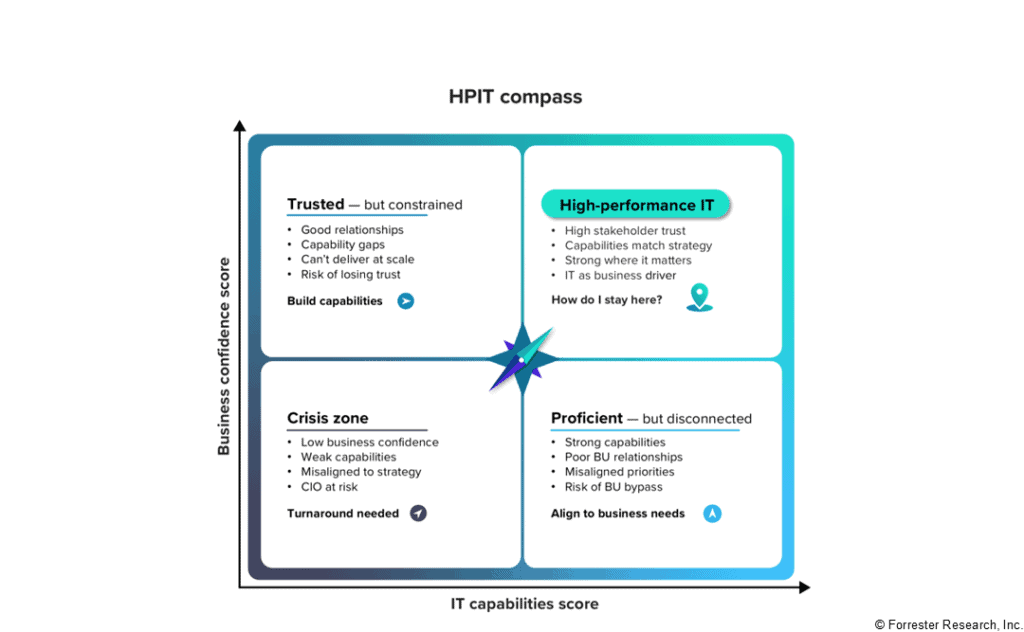
The intersection of business confidence and technical excellence defines High-Performance IT. Where these dimensions diverge, IT strategy will struggle. Where they align, CIOs are successfully building alignment, adaptability and trust. For example:
- In the state we previously discussed where central IT consolidated over 20 IAM systems, the CIO focused first on building relationships with agencies by demonstrating operational benefits like enhanced data loss prevention and digital access policies. In fact, following the “roadshow,” the CIO held a plenary meeting with all agencies where agencies swayed by the benefits of consolidation became advocates in convincing “holdout” agencies to participate. Only after this collaboration did the CIO use political pressure to drive full participation. This approach built trust and alignment by the CIO giving each agency an opportunity to be heard during the roadshow, which even resulted in agencies shifting from customers to partners. And the project built adaptability by enhancing the state’s collective ability to mitigate and respond to threats. As a result of leveraging the principals of High-Performance IT, this CIO resolved the First Mover Penalty for over 20 agencies (since most had their own discrete IAM tenants), substantially offset the Local-Global Divide and skillfully navigated the Trust-Authority Balance.
- One state has an IT governance council sponsored by the governor’s office that acts as a monthly touch point for all stakeholders. The forum frequently identifies agency-led initiatives that could be adapted to generate broader value across all agencies and provides political backing to expand them proactively, leveraging the “Trust-Authority Balance” and mitigating the “Local-Global Divide.” It also scrutinizes projects for return on investment and other mission impacts for the state. This type of collective, cross-functional forum is a substantial asset in cost optimization, as it centralizes the discussion to ensure end-to-end alignment and generates consensus for the best use of IT funding.
- Faced with pressure to reduce spend, one state resists treating tech cost-cutting as an IT-only problem. Rather, one of the first moves the state took was to present leaders not with a rundown of dollars to cut, but rather a menu of impacts they can choose from to understand where mission outcomes are fungible and where they need to be preserved. This demonstrates adaptability by allowing resources to shift in response to changing fiscal conditions while preserving critical capabilities. It also strengthens alignment by ensuring that the CIO priorities are in lock step with agency leaders even during times of belt tightening – the focus remains on protecting agency and constituent outcomes to offset the “Local-Global Divide.”
Everyone Knows What Technology Costs – The Ultimate Step is to Understand What It Creates
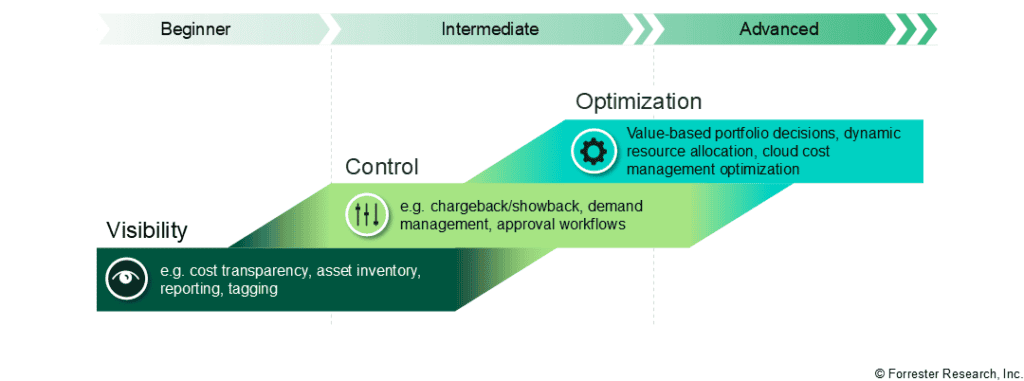
Forrester’s IT Spend Management Framework defines IT spend management in three progressive layers – visibility, control and optimization. Most states are advanced when it comes to both transparency of IT spend and controlling IT costs. This makes sense, as budget offices and agencies closely scrutinize every dollar spent and billed by central IT. In fact, one state CIO even commented that their state’s agencies treat billings as if they were “coming from a third-party vendor.” However, most states are less advanced when it comes to optimization, i.e. moving beyond simply spending less to spending better by maximizing the value derived from every dollar and strategically reinvesting savings to fuel growth and innovation. Examples of how state CIOs are optimizing include:
- One state that uses a chargeback approach has access to an appropriated innovation fund, insulating it against the “Funding Cliff.” For new technologies, it focuses first on spend visibility and control before moving to optimization. For example, before launching new AI initiatives, leaders established policies, governance and spending controls to manage risk and guide adoption. With that foundation in place, it funded initiatives such as an AI-powered citizen support chatbot and evaluated success using outcome-oriented measures like caller satisfaction and issue resolution times. The state also invested in an innovation lab that gives agencies a safe environment to explore new use cases while at the same time acting as a talent magnet. So optimization isn’t (just) about reducing spend. It is about redirecting resources toward higher-value outcomes for citizens, agencies and the entire state.
- The biennial planning process is a challenge to cost optimization, as it constrains the ability to adapt to rapidly shifting priorities, i.e., the “Planning Trap.” In some states the biennial budgeting model is supplemented with an annual interim review and a supplemental funding request process that allows leaders to revisit assumptions, adjust technology investments and account for emerging needs. This creates opportunities to optimize spending throughout the budget cycle rather than waiting years for the next planning period. In doing so, the states navigate the “Planning Trap” and create the ability to adapt to rapidly evolving technologies such as AI.
- One CIO described how maturing visibility and control enabled the state to creatively optimize for technical debt. It first developed total cost of ownership (TCO) visibility for each application. It then embarked on a modular strategy to application modernization where it built new functionality alongside legacy systems, then migrated capabilities incrementally over time. Being resource constrained, it could have never funded a wholesale modernization. But armed with the TCO of the capabilities it was updating modularly, it was able to prove the incremental reduction in application costs and repurpose funding for tech debt remediation. This illustrates that even resource-constrained organizations can make meaningful progress by combining strong cost visibility with incremental, outcome-oriented investment decisions.
Navigate the Forces of Change
Once you’ve leveraged frameworks like High-Performance IT, the IT Spend Management Framework or others to determine what to change, you can then consider employing the Government Change Framework presented in the NASCIO CIO as Broker series. It can help you determine how to make the change and what relationships and change forces to leverage. The Government Change Framework describes four forces of change that are bi-directional. Political, customer, market and inertial forces not only influence the investment agenda of the state CIO, the state CIO in turn leverages those same forces to execute on that agenda.
Interviews with state CIOs demonstrate that states already understand the destination. The challenge to change is maintaining momentum while balancing political, market, customer and inertial forces. Successful state CIOs accept these forces and use them to build support for change, creating modernization strategies that are both politically sustainable and operationally achievable. Examples include:
- In 2023, Governor Reynolds of Iowa proposed, and the legislature passed, a bill that included reducing the number of cabinet agencies by more than 50%. The Iowa CIO, who over the years had evolved the state’s centralized IT group from a mainframe support outfit to a shared services provider for a limited number of agencies, embraced the “Trust-Authority Balance” and presented a case to the governor to centralize all IT shared services as part of the consolidation. Investing in political relationships and anticipating how political forces can drive change were the keys in this instance – if the CIO had waited until the bill was introduced, he wouldn’t have had a line to the governor and would not have had time to build the case for the change.
- One CIO stated that they “just didn’t have the money” for LLM engineers to build models for Medicaid fraud detection. So, they partnered with a trusted corporate partner to leverage that supplier’s in-house capabilities to flag claims for further review while the state built its own capabilities. This is an example of leveraging the market for resources that don’t exist internally and resonates with the CIO as Broker model that employs resources from multiple sources – inside and outside the state enterprise. It also highlights how CIOs can use market forces to accelerate capabilities that take time to mature organically and offset the Funding Cliff by looking to external partners in lieu of one-time funding.
- One state pursued a customer-centric model by flipping the conversation from technology-first to leading with end user experience. For example, after it set up business technology strategists to work with leaders from across agencies, it got feedback that unemployment claimants were frustrated spending 20 minutes on average phoning in claims. In response, the state is rolling out mobile and desktop claims tools that reduce time-to-file by 50 to 60 percent. By leading with the customer, the case for change is selling itself. It’s also mitigating the “Local-Global Divide” by shifting the focus from cost to outcomes.
- Inertial forces are headwinds every CIO faces in effecting change. In fact, multiple CIOs reported that policy concerns, biennial cycles and spend volatility are forcing them toward a more measured adoption of AI. This actually has its advantages – these CIOs spoke about using the resources they have to educate their workforce in AI and inventory potential AI utilizations. Meanwhile, Forrester observes gaps in AI spending controls and lagging workforce readiness with AI (what it calls “AiQ”). Getting policy and AiQ right before more heavily investing in AI may actually enhance chances for long-term success and offset the First Mover Penalty. Successful CIOs work with inertia rather than fighting it.
“We’re here for our citizens and making sure we’re focused on the outcomes that bring them better services more efficiently.” Shawnzia Thomas, CIO, State of Georgia
Actions CIOs Can Take Right Now – And Actions They Shouldn’t
State CIOs vary significantly in how they organize, fund and govern technology, and there is no one-size-fits-all model. Leveraging feedback from CIOs on lessons learned and challenge areas and considering the insights that the frameworks presented in this report provide, the following are actions leaders can take now that translate these lessons into practical steps….and a few they shouldn’t. The goal is not that all of the following recommendations will resonate for each and every CIO. Rather, given the variety of models and ingredients for success that exist across all states, each CIO will ideally find a few takeaways that will help right away on their modernization journey.
Do’s
- Demand that every major technology proposal tie to a mission outcome. State CIOs get better buy in and support from their governors, their legislature and from their agencies when new investments tie back to a mission outcome that the state is looking to drive. For example, one state is successfully modernizing with cloud, AI and other technologies. How? The CIO is able to share success stories in every cabinet meeting that all tie to mission outcomes. One state leveraged AI to save $12 million on the purchase of train equipment for their state department of transportation and avoid a significant increase in staff to handle the burgeoning demand for the Supplemental Nutrition Assistance Program (SNAP) benefits within their state health and human services department. These actions resonated with the state’s leaders and helped avoid the “Local-Global Divide.” These same state leaders became the new advocates and are instrumental in enabling further innovation and modernization. The value story is the first step toward this reinforcing value loop – make a well-articulated value proposition compulsory for every project.
- Scratch and claw for innovation funding. Funding technology experimentation needs to be at the top of every CIO’s list. It’s a challenge when agency first-movers are penalized and one-time innovation funding incentivizes short-term decision making that has long-term consequences. A standing innovation fund resolves this and helps avoid the “Funding Cliff,” “First Mover Penalty” and the “Planning Trap.” Ideas to kickstart innovation funding include (1) adding it as an assessment to agencies based on some criteria, (2) repurposing budget savings as seed capital and growing a fund gradually and (3) partnering with trusted third parties to fund innovation hubs where students develop technologies in a sandbox environment which can then be adopted by agencies when they are ready for production.
- Assign agency relationship managers. CIOs whose organizations are embedded in the activities of the agencies they support will see better outcomes, avoid the Local-Global Divide and optimize the Trust-Authority Balance. High-Performance IT data proves it. Build this relationship by identifying agency business relationship managers as has been accomplished in several states. This doesn’t require adding new roles. Rather, many organizations begin by shifting the focus of an existing team member to one or several agencies as a proof of concept, then scaling it only once a successful model is in place. One indicator of success is that business relationship managers within the state CIO organization are pulled into important strategy discussions within agencies rather than having to seek these discussions out.
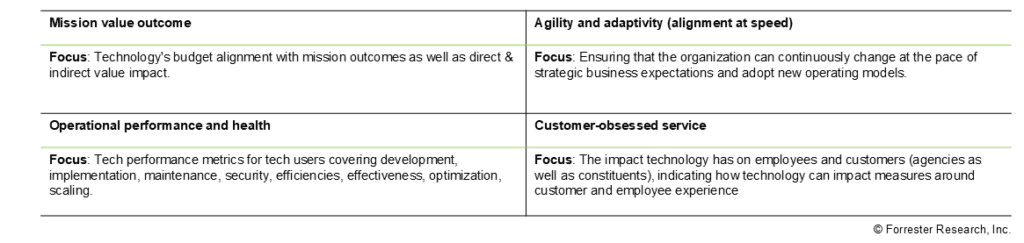
- Launch a balanced scorecard report. The balanced scorecard is an underrated tracking tool that is perfect for leaders managing tradeoffs. The quadrants of a balanced scorecard are intentional and contain metrics mapped to interdependent perspectives. For example: business value, operational efficiency, agility and customer service. Organizations have a fixed pool of resources and need to make choices as to where they allocate those resources (and where they don’t). Using the template like the one below, establish metrics for the scorecard quadrants and see how the decisions you make regarding resources impact your effectiveness in each quadrant. This in turn helps leaders manage the “Trust-Authority Balance” and minimize the “Local-Global Divide.”
Starting with the “focus” for each quadrant, develop metrics that (a) illustrate how the IT organization is developing alignment, adaptivity and trust with non-IT stakeholders, (b) are not just measurable but reflect change over time and (c) tie back to the broader mission outcomes of the state.
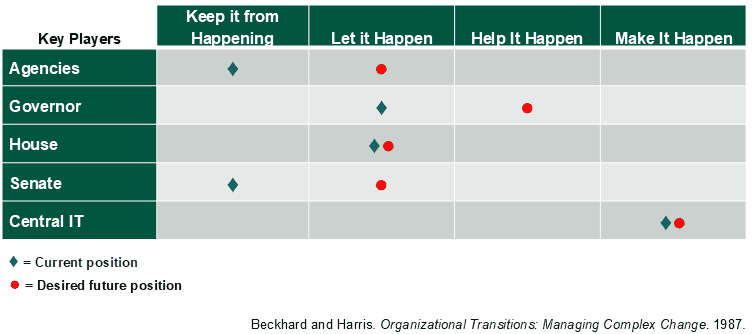
- Create personas for every agency and political stakeholder. Savvy state CIOs understand that managing stakeholder relationships means understanding that every stakeholder is different and requires a different approach. One state CIO understands the differing motivations between the governor, cabinet directors and legislature and plots their approach to each accordingly as they navigate the “Trust-Authority Balance.” As a result, the CIO is able to effectively communicate the value story to the various audiences and ultimately garner support when needed for key requests. CIOs should create full personas for each stakeholder, including their day-to-day priorities and key sensitivities. “Knowing your audience” is critical for leaders looking to drive support for changes in how financial management of IT is done in their state. In fact, a tool like the commitment chart below, which maps out supporters and blockers to change, is an excellent complement to a persona analysis.
Use the commitment chart structure to conceptualize who your stakeholders are and what role they play in facilitating or resisting the change you’re pursuing.
- Join up with other states for purchasing power when permissible. Cost optimization is focused on maximizing the value of a CIO’s total budget. Lowering costs is part of this equation and assists in managing the Funding Trap. Partner with other states that have similar purchasing priorities and timing such as the partnership between Arizona and Hawaii enabling Hawaii to leverage Arizona’s Medicaid Management Information System (MMIS), as well as the Texas Cooperative Contracts Purchasing Program, which allows other states access to the offerings, services and solutions that have been pre-vetted by the State of Texas. Hardware purchases are one category to start with, as they are easy to attribute to alleviating any transparency concerns. Savings also scale proportionately with volume, so there are real incentives to “joining up.”
- Use governance to create value, not just control risk. Don’t treat a governance review board as a compliance function focused on approving purchases, reviewing contracts or enforcing standards. Rather, use it as a forum to collectively identify opportunities to scale successful initiatives, reduce duplication, align technology spending with mission outcomes and continuously reprioritize investments as conditions change. These forums are a common venue where stakeholders from agencies, central IT, cabinet and the legislature can assess investments for redundancy and scale before critical decisions are made, helping mitigate the First-Mover Penalty and Local-Global Divide. They also provide states with longer planning cycles an opportunity to revisit assumptions midstream, and help offset the Planning Trap. Start small: leverage the CIO’s approval authority to drive visibility into major technology investments, evolve toward a formal intake and prioritization process and mature to a strategic value office that actively shapes where technology dollars generate the greatest public value.
Don’ts
- Don’t Eliminate the chargeback model without a prioritization plan. Eliminating the chargeback model doesn’t fully resolve the First Mover Penalty or Local-Global Divide – it just masks them. Even if agencies aren’t being directly billed for their initiatives, they’re still concerned about inequity in how central IT prioritizes initiatives. For example, following a switch from a 100% chargeback model to a fully appropriated IT model in 2022, one state described prioritizing strategic spend on IT as “a challenge.” It also found that demand from agencies became elevated when they were no longer financially accountable. So, there is still a cost to agencies in the fully appropriated model. It just changes from a monetary cost to the cost of having to compete for attention.
- Don’t let agencies conflate cost recovery with market pricing. Rates charged by central IT organizations to agencies are frequently compared by agencies to managed service providers (MSPs) and other third-party service providers. While it’s appropriate to expect a competitive level of service from a central IT organization, this is not a like-for-like comparison and adds to the Local-Global Divide. For example, one CIO noted an instance where an agency procured a direct bid for a software license equal to the rate it was being charged by central IT for the capability. However, it hadn’t considered that security, resilience, staffing, integration, network, risk management and other enterprise services managed by the CIO organization were also included in the amount it was being billed for that capability. When it considered the total cost of the capability, the picture changed drastically. Clearly communicate to agencies the full extent of what they are being billed for and the value that central IT is providing to prevent these types of situations.
- Don’t cut technology staff before addressing structural waste. A common response to the Funding Cliff and other cost reduction mandates is to cut staff. Some states even experience years of technology staffing reductions. But workforce cuts hollow out the capability needed to execute modernization strategies, manage risk and maintain reliable citizen services. Rationalize first. Examine more sustainable and defensible savings opportunities such as duplicate contracts, overlapping tools, fragmented services, unused licenses and underutilized platforms before turning to staffing reductions. It will lead to better, more sustainable cost reduction and modernization outcomes without sacrificing critical capabilities.
About NASCIO
Founded in 1969, the National Association of State Chief Information Officers (NASCIO) represents state chief information officers (CIOs) and technology executives and managers from the states, territories and District of Columbia. NASCIO’s mission is to advance government excellence through trusted collaboration, partnerships and technology leadership. NASCIO provides state CIOs and state members with products and services designed to support the challenging role of the state CIO, stimulate the exchange of information and promote the adoption of IT best practices and innovations. From national conferences to peer networking, research and publications, briefings and government affairs, NASCIO is the premier network and resource for state CIOs.